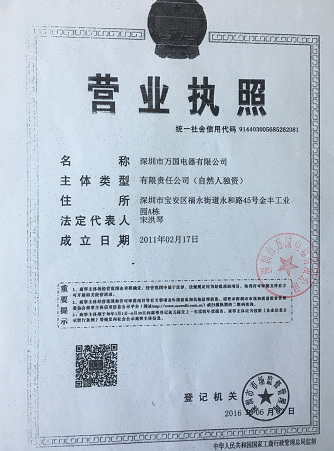
Welcome to visit the official website of Shenzhen Wanguo Electric Co., Ltd!


17 years focus on commercial display field
LED LCD R & D production sales service


03
2021-11
Advertising machine manufacturer: A brief introduction to advertising machines
With the prevalence of advertising machines, plasma, LCD and other flat-panel display devices, and the development of network streaming media technology, the system architecture has undergone several generations of changes, from displays and DVD players or PCs. After the introduction of network technology, dedicated network media players have replaced traditional pure DVD or PC playback methods, providing richer functionality and more diverse applications. Therefore, some people have listed it alongside print media, broadcasting, television, and the internet as the "fifth media," with the ability to deliver information to a specific audience at a specific time and place.
23
2021-08
LG Display targets China's multi-billion dollar commercial display market
LG Display Strikes Gold in China's Hundreds of Billions Commercial Display Market
China Economic Net
Published: 2020-08-25 13:56 China Economic Net Official Account, High-Quality Finance Field Creator
Beijing, August 25 (Economic Daily-China Economic Net) - LG Display recently announced that it will provide the world's first transparent OLED display screens for subway windows in Beijing and Shenzhen. The windows can display various information to passengers in real time—train operation information, LBS location service information, rail transit transfer information, real-time flight information, road traffic congestion information, weather forecast information, etc.
Transparent OLED uses the self-emissive characteristics of OLED, with the advantage of high transmittance, and has received widespread attention in the fields of autonomous driving, aviation, subway and other mobile travel, smart home, and smart buildings.
It is understood that the screen provided by LG Display for Beijing and Shenzhen subways is called "magic screen", and the product's transparency can reach 40%. OLED does not require a backlight source, each pixel emits light by itself, and the structural advantages are conducive to achieving high transmittance. Compared with LCD, OLED has the advantages of high transmittance, high pixels, and wide viewing angle.
The industry believes that transparent OLED has broad application prospects. At this year's CES exhibition, the transparent OLED window displayed by LG Display attracted widespread attention. In the Chinese market, the commercial and special display industry is booming. Xiaomi Corporation just released its first transparent OLED TV a few days ago. Previously, at IFA 2019 in Germany, Skyworth showcased a transparent OLED TV.
In addition, the 55-inch transparent OLED mounted on the streamlined wall inside the aircraft cabin displayed by LG Display at CES this year gives the narrow and enclosed space an open feeling, allowing passengers to be in a wide field of vision, refreshing the appearance of the aircraft and improving the grade of the aircraft's first-class cabin.
Furthermore, transparent OLED has huge development potential in the mobile travel industry such as autonomous driving cars. The transparent OLED displays the in-car entertainment system, which will greatly enhance the passenger's riding experience and feel the differentiated value. LG Display, a global display industry giant, said that it is actively developing the Chinese market and exploring the huge potential of the transparent OLED market in the fields of autonomous driving vehicles, aviation, rail transit, and subways.
Data from Prescient & Strategic Intelligence, a global market research institution, shows that the market size of transparent displays was US$524 million in 2018 and will reach US$4.933 billion in 2024, with a compound annual growth rate of 46%.
In the Chinese market, in recent years, driven by the Internet of Things, smart society, and consumer upgrade needs, with the help of 5G and 8K digital economic environments, and under the wave of display technology innovation centered on large-size OLED, commercial displays have fully exploded and entered a new era.
At the "2020 China Smart Display Omni-Commercialization Summit" held in early August, relevant personnel from the China Electronic Visual Industry Association introduced that the commercial and special display industry is developing rapidly. In 2019, the scale of China's traditional public information display market reached 177.8 billion yuan, exceeding the scale of the consumer-grade television market. It is expected that the market size will exceed 300 billion yuan in 2025, which is a blue ocean market. Facing the huge market space in China, LG Display said that it is actively developing the Chinese market and exploring the development potential of transparent OLED in the fields of autonomous driving vehicles, aviation, rail transit, and subways, as well as smart homes and high-end retail markets, providing differentiated value.
It is understood that LG Display is currently the only manufacturer in the world that can mass-produce large-size OLED and transparent OLED panels. In addition, LG Display is also developing bendable transparent OLED products. In 2017, LG Display became the world's first company to successfully develop a 77-inch UHD transparent flexible display, which established LG Display's leading position in the transparent OLED display industry. With its leading transparent OLED display technology advantages, LG Display leads the fields of autonomous driving, aviation, subway and other mobile travel, smart homes, and high-end television markets, providing differentiated value of transparent OLED.
Source: Economic Daily-China Economic Net
23
2021-08
LG CX OLED TV Review: Still One of the Best TVs on the Market
LG CX OLED TV Review: Still One of the Best TVs on the Market
LG CX OLED TV Review: Still One of the Best TVs on the Market
Sina Finance APP Reduce font sizeEnlarge font sizeCollectionWeiboWeChatShare1
New and cool products can be tried for free at the first time, and there are many high-quality experts sharing unique life experiences. Come to Sina Zhongce and experience the most cutting-edge, interesting, and fun products in various fields~! Download the client to get exclusive benefits!
This article is from ZNDS Information.
LG OLED TVs have always had a good reputation in the TV market. Compared with the very popular LG C9 last year, the LG CX OLED TV has not changed much.
Although the LG OLED65CX has been surpassed by the updated model LG C1 OLED, the CX is still a very worthwhile TV to buy, and it is still a good choice for gamers who have a PS5 or Xbox Series X and want one of the best gaming TVs.
Appearance
(Image source: LG)
The LG OLED65CX has an eye-catching appearance, with an ultra-thin body that looks more technologically advanced. Although the back part is protruding, the design is good, and the speakers and processor are placed here.
The screen is connected to a centrally mounted metal plate bracket, which is well-made but feels a little heavy.
The OLED65CX has four HDMI ports, all of which can handle 4K 120Hz audio and video, which is particularly important for gamers. One of the HDMI ports also supports ARC/eARC (Audio Return Channel), so the TV can output Dolby Atmos from streaming services or 4K Blu-ray to compatible soundbars or AV receivers.
The last design point worth mentioning is the OLED65CX's remote control, which has a finger groove on the ergonomically designed back, so it feels comfortable in the hand and allows you to quickly browse the menu list via the central scroll wheel on the remote control.
(Image source: LG)
Like LG's other OLED TV product lines, the LG OLED65CX is equipped with LG's WebOS interface.
LG is also a leader in voice recognition, and the OLED65CX supports LG's own ThinQ AI platform, Amazon Alexa, and Google Assistant. Support for all of these is built-in, meaning no external listening devices are needed.
In terms of supported applications, you'll find relatively new additions to the streaming space, such as Disney+ and Apple TV+, as well as all the usual suspects such as Hulu, Netflix, and Amazon Prime in the US. However, there's an unexpected hurdle for UK buyers: LG and Freeview Play haven't completed their usual deal for the Korean brand's 2020 TVs, meaning there's currently no sign of the UK's major terrestrial catch-up apps, such as BBC iPlayer, ITV Hub, All 4, and My5.
The biggest selling point of the new webOS features is the sports category integration. Just select your favorite team in the list, and the TV will provide score updates and broadcast alerts when the team is playing.
(Image source: TechRadar)
HD/SDR Performance
OLED TVs have always been particularly well-suited to standard dynamic range (SDR) technology.
The TV's picture is rich and vibrant in color, with good contrast and perfect detail. When displaying dark areas, it performs well due to its ability to locally control the light.
LG has also improved the 2020 upgrades. This is probably due to the introduction of LG's new third-generation Alpha 9 chipset. After the improvement, the details are clearer after enlarging the HD picture.
4K/HDR Performance
Although the OLED65CX has a great HD SDR image, its upgrade to 4K and HDR images is even more significant.
First, the black level is deeper. Compared with last year's B9, the CX combines improved black level and shadow detail.
Compared with previous LG OLEDs, the OLED65CX has less noise in dark areas when watching dark scenes in some streaming programs, without losing the shadow detail caused by LG's earlier attempts to fix this well-known blocking phenomenon.
(Image source: LG)
The OLED65CX also improves LG's color performance. For example, enhanced brightness management helps the brightest colors in HDR images maintain a more natural appearance, making the colors across the screen look more consistent.
4K images also look very clear and detailed, and the clarity looks very comfortable and natural as long as you don't set the preset for vibrant scenes.
(Image source: LG)
Picture Mode
The OLED65CX has two new picture modes: Filmmaker Mode, launched through a collaboration between the UHD Alliance and filmmakers, aims to reproduce on the TV the kind of settings used by creators when mastering content. This means turning off some of the TV's image processing tools, which some may find results in a slightly jittery picture and too dull to watch in a bright room. But in fact, there is not much difference.
Another image mode is Dolby Vision IQ. This is essentially a Dolby Vision mode that combines the extra HDR picture information and screen optimization elements of Dolby Vision HDR with an assessment of room conditions sensed by a built-in light sensor. To ensure a consistent picture regardless of changing viewing conditions.
For gamers, using the LG OLED65CX for gaming will be smoother. In game mode, it has an input lag of only 13 milliseconds. It supports automatic low-latency mode switching and variable refresh rate.
Of course, as with other OLED TVs, users need to pay attention to the content being watched to reduce the possibility of image retention. Try to avoid watching content with bright logos or static bright image elements for too long.
(Image source: LG)
Sound
The LG OLED65CX supports Dolby Atmos, and the sound quality is indeed good. It is worth mentioning that the LG OLED65CX has an AI Sound Pro option. This mode optimizes the sound based on the capabilities of the TV speakers, resulting in a more dynamic and louder sound.
It somehow manages to emanate from its incredibly slim body: the soundscape produced has real width and even some verticality, especially if you ditch the default Dolby Atmos sound setting and opt for LG's excellent AI Sound Pro option. This mode optimizes the sound based on the capabilities of the TV speakers for a more dynamic, louder, and impactful sound.
Summary
The LG OLED65CX is a superb TV that delivers detailed and vibrant images for movie lovers and gamers alike. Its improved game mode picture technology is especially appealing to gamers. Therefore, regardless of your needs, the LG OLED65CX has an irresistible appeal.
23
2021-08
LCD, LED, OLED, QLED - Confused? Understand them all in one go!
Confused about LCD, LED, OLED, and QLED displays? Let's clarify! Smart commercial displays empower Wanguo intelligent advertising machines today. Source: Knowledge Cool. LCD LCD stands for Liquid Crystal Display. There are several types of LCD screens, including TFT, UFB, TFD, and STN. The structure of an LCD involves placing a liquid crystal cell between two parallel glass substrates. The lower substrate glass has a TFT (thin-film transistor), and the upper substrate glass has a color filter. The rotation of the liquid crystal molecules is controlled by the signals and voltage on the TFT, controlling the emission of polarized light from each pixel to achieve display purposes. LCD is a substance between solid and liquid states; it cannot emit light by itself and requires an external light source. Therefore, the number of lamps affects the brightness of the LCD. LED LED (Light-emitting diode) screens. The images on these displays are still generated using liquid crystals; light-emitting diodes are only used as light sources. Technically, they are still LCD displays, or LED-backlit LCD TVs. LED screen LCD TVs have advantages such as small size, low power consumption, long lifespan, low cost, high brightness, wide viewing angle, and high refresh rate. However, they have disadvantages such as poor color performance, especially noticeable color deviation in folded areas of the LCD screen. OLED OLED (Organic Light-Emitting Diode). Although only one letter different from LED, they describe completely different things. We know that liquid crystal panels emit light through a backlight source and produce various colors through the refraction of liquid crystal molecules. Liquid crystal molecules themselves cannot emit light, while LED refers only to the backlight source. OLED, however, can emit light itself and therefore does not need a backlight source. LEDs use metallic materials, while OLEDs use organic materials. They can emit light independently without light irradiation, resulting in better contrast. Regular LEDs require backlight illumination to be visible. Currently, the materials used in light-emitting diodes are inorganic semiconductor materials, which are difficult to apply to large-area components with high resolution (e.g., screens). Solving these problems relies on new organic semiconductor materials (i.e., materials containing carbon and hydrogen compounds). When coated on conductive glass and energized, they emit light of various wavelengths. QLED QLED stands for Quantum Dot Light Emitting Diodes, a self-emissive technology that does not require an external light source. Quantum dots are extremely small semiconductor nanocrystals invisible to the naked eye, with a particle size of less than 10 nanometers. Quantum dots have a unique property: when stimulated by light or electricity, they emit colored light. The color of the light is determined by the composition, size, and shape of the quantum dots. The frequency can be precisely adjusted by changing the size, shape, and material of the quantum dots, enabling various applications. The structure of QLED is very similar to OLED technology. The main difference is that the light-emitting center of QLED is composed of quantum dot material. Its structure involves electrons and holes converging in the quantum dot layer to form photons (excitons), and light emission through photon recombination.
Complete Categories
Save worry and effort, buy all at one stop.
One-to-one customer service
Selection inquiry, fast response
Delivery Guarantee
Multi-warehouse straight hair, worry-free delivery period
Genuine Supply
genuine goods security, integrity services
National Hotline:13430872800
Liu Guohua (Chairman):13430872800
Telephone:86-755-29929990
E-mail:wanguotv@126.com
Copyright©2025 Shenzhen Wanguo Electric Co., Ltd. All rights reserved.